US Department of Agriculture has published a proposed rule, aiming to close the "gaps in the current regulations to build consistent certification practices to deter and detect organic fraud."
Part of the proposal will aim to reduce businesses exempted from organic certification. improving traceability with better recordkeeping, and standardizing inspections of organic operation sites.
USDA’s Economic Research Service (ERS) has published its annual International Food Security Assessment, which shows that the worldwide coronavirus pandemic has made food security worse.
The annual report determines how much access people in 76 low and middle-income countries have to food. The answer to that question requires tracking incomes, food prices, and other economic factors including agriculture production and market conditions.
“In the 76 low- and middle-income countries examined in the report, the number of people considered food insecure in 2020 was estimated at almost 761 million people or 19.8 percent of the total population. The shock to GDP from COVID-19 is projected to increase the number of food-insecure people by 83.5 million people in 2020 to 844.5 million and increase the share of the population that is food insecure to 22 percent.”
AOAC International's Food Authenticity Task Force has developed standard method performance requirements (SMPR) for targeted and non-targeted food authenticity methods. SMPR set minimum performance criteria that food authenticity testing methods for milk, honey and olive oil need to fulfil.
Further information was provided in a recent free-of-charge webinar, which can be viewed on registration.
Digital PCR (dPCR) has developed considerably since the publication of the Minimum Information for Publication of Digital PCR Experiments (dMIQE) guidelines in 2013, with advances in instrumentation, software, applications (including for food authenticity), and our understanding of its technological potential.
Yet these developments also have associated challenges; data analysis steps, including threshold setting, can be difficult and preanalytical steps required to purify, concentrate, and modify nucleic acids can lead to measurement error. To assist independent corroboration of conclusions, comprehensive disclosure of all relevant experimental details is required.
To support the community and reflect the growing use of dPCR, an update to dMIQE, dMIQE2020, has been published including a simplified dMIQE table format to assist researchers in providing key experimental information and understanding of the associated experimental process.
Adoption of dMIQE2020 by the scientific community will assist in standardizing experimental protocols, maximize efficient utilization of resources, and further enhance the impact of this powerful technology.
The effects of the COVID-19 pandemic are being felt across the food supply network.
The Chairman of our Advisory Board, Sterling Crew, has published a paper for the IFST, in which he reviews the potential food authenticity challenges created by the pandemic and the mitigation of the emerging risks and threats.
Many of the risk factors for food fraud have increased across the global food supply network due to the COVID-19 outbreak. Steps taken following the horsemeat incident and the Elliott report have strengthened the UK’s food supply network authenticity controls and helped to mitigate vulnerability to COVID-19 related fraud..Chris Elliott
The pandemic has highlighted some of the weaknesses in the nature and complexity of the global food network. The UK food industry must assure the authenticity of food by continuing to minimise the vulnerability to food fraud , by building resilience to possible future shocks and by mitigation of the emerging authenticity risks and created by COVID-19.
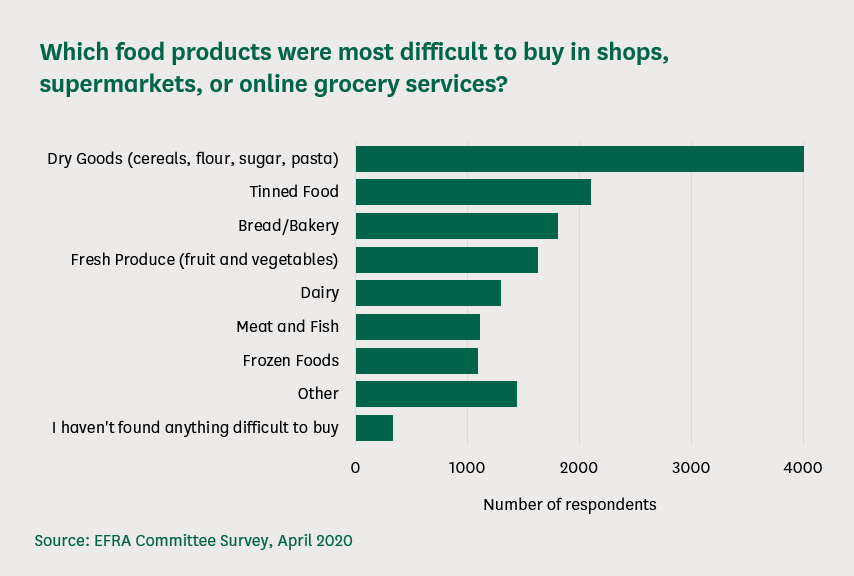
There was a lack of clarity about how much food people needed to buy.
The pandemic made more people unable to afford food.
Foodservice and hospitality businesses and their suppliers are going to feel the effects of lockdown for years.
EFRA's key recommendations to fix the problem
1.Ensuring people can afford enough healthy food is the responsibility of multiple Government departments. To bring that work together, the Government should appoint a Minister for Food Security who is empowered to draw together policy across departments on food supply, nutrition and welfare.
2.The Government should work with producers, processors and wholesalers servicing the hospitality and foodservice sector to monitor the health of food and drink suppliers as supply chains restart.
3.The Department for Environment, Food and Rural Affairs (DEFRA) should continue to provide £5 million in annual funding to FareShare to redistribute surplus food from farms and across the supply chain to frontline food aid providers for a further two years. This would help those who struggle to afford food as the effects of the pandemic continue, and reduce food waste from farms.
4.Food supply to supermarkets continued because we were able to keep food coming into the country. Future crises could stop this flow and cause more serious problems. The Government has to update its food resilience plans, taking into account how consumer behaviour can disrupt food supply and whether our efficient "just-in-time" supply chains are as resilient as they need to be.
Learning Science and the UK National Measurement Laboratory (NML) are pleased to launch Praxis, our jointly developed interactive web based training.
Visit https://praxislearn.co.uk/ for details of our new analytical measurement package – Core Laboratory Skills for Chemical and Biological Measurement Scientists – that will be ready later this summer.
The Environment Secretary Michael Gove appointed Henry Dimbleby to conduct this year-long review, and to then set out my recommendations within six months of its completion. Government will then publish an ambitious, multi-disciplinary National Food Strategy, the first of its kind for 75 years, in the form of a White Paper.
Part One of the UK National Food Strategy has been published; the recommendations cover two main themes:
• Making sure a generation of our most disadvantaged children do not get left behind.Eating well in childhood is the very foundation stone of equality of opportunity. It is essential for both physical and mental growth.
• Grasping the once-in-a-lifetime opportunity to decide what kind of trading nation we want to be.The essence of sovereignty is freedom – including the freedom to uphold our own values and principles within the global marketplace.
Over the next year the team will speak to people from across the food chain, from farmers in the field to chefs in the kitchen. We will consult experts from around the world, as well as those whose voices are seldom heard, but who have personal experience of the failings of our food system: low-paid workers in agriculture and food production, people with diet-related diseases, farmers living on the margins, and many more.
Today, amidst COVID-19 lockdown and growing pandemic, global food value chains stand disrupted across all commodities. Food safety has been a growing global concern that is only set to rise in this COVID world. It is in these times that it has become more imperative than ever, to ensure unadulterated and safe food across global food value chains.
Digitisation of such value chains towards making food safe, trackable and of desired consumer quality, needs to be accelerated and implemented at a much faster pace than ever.
SourceTrace is a globally leading name in traceability and has already implemented solutions across diverse sectors such as fruits and vegetables, organic cotton, vanilla, aquaculture, flavours and fragrances, spices, honey and more. Working across 28 countries since 2013, SourceTrace’s DATAGREEN platform helps companies track their produce from global locations across all stages while maintaining complete transparency and assurance of quality.
AgNext solves the problem of quality, bringing the best of the technology world for agribusinesses. Using state-of-art technologies in computer vision, spectroscopy and Internet-of-Things (IoT), AgNext has created the singular platform QUALIX, through which trade quality and safety parameters for multiple commodities could be assessed in a minute, enabling agribusinesses to leapfrog their procurement and operations processes, optimise costs, provide traceability, sharpen and smoothen blockchains and most importantly produce excellent products of highest quality for consumers and ensure fair-trade practices with farmers.
Helping businesses ensure the quality of food right from the farm-gates to the consumers, AgNext has partnered with key nodal institutions in multiple commodities and has also been working with leading corporates in each of the segments.
By combining their solutions and signing an MoU, AgNext and SourceTrace have created a technology platform, TraceNext, that can provide complete value chain traceability with an assurance of quality from the farm-gates to the consumer.
The benefits for such a platform as TraceNext, brings immense value to multiple commodity value chains, ensuring various aspects like
Trace food origin and chain of custody
Monitor ethical and sustainable practices used in growing food
Complete value chain traceability – from farm to consumer
Legal and compliance norms
Instant quality testing on trade and safety parameters
Instant trade decisions without any delays and dependencies
Ensure blockchain and fair-trade practices in commodity supply chains
Modern supply chains have evolved into highly complex value networks and turned into a vital source of competitive advantage. However, it has become increasingly challenging to verify the source of raw materials and maintain visibility of products and merchandise while they are moving through the value chain network.
The application of the Internet of Things (IoT) can help companies to observe, track, and monitor products, activities, and processes within their respective value chain networks. Other applications of IoT include product monitoring to optimize operations in warehousing‚ manufacturing, and transportation. In combination with IoT, Blockchain technology can enable a broad range of different application scenarios to enhance value chain transparency and to increase B2B trust. When combined, IoT and Blockchain technology have the potential to increase the effectiveness and efficiency of modern supply chains.
The contribution of this paper is twofold. First, we illustrate how the deployment of Blockchain technology in combination with IoT infrastructure can streamline and benefit modern supply chains and enhance value chain networks. Second, we derive six research propositions outlining how Blockchain technology can impact key features of the IoT (i.e., scalability, security, immutability and auditing, information flows, traceability and interoperability, quality) and thus lay the foundation for future research projects.
Europol and INTERPOL coordinated operation OPSON 2020 which targeted trafficking of counterfeit and substandard food and beverages. The ninth operation of its kind, it ran from December 2019 to June 2020 and involved law enforcement authorities from 83* countries and was also supported by the European Anti-Fraud Office (OLAF), the European Commission, the European Union Intellectual Property Office (EUIPO), national food regulatory authorities and private sector partners.
Counterfeit and substandard food and beverages can be found on the shelves in shops around the world. The increasing online sale of such potentially dangerous products poses a significant threat to public health. Operation OPSON was created to combat organised crime involved in this area. This year’s operational activities have found a new disturbing trend to address: the infiltration of low-quality products into the supply chain, a development possibly linked to the COVID-19 pandemic.
Condiments also a highly counterfeited product
This year’s operation OPSON led to the dismantling of 19 organised crime groups involved in food fraud and the arrests of 406 suspects. More than 26 000 checks were performed. As a result, about 12 000 tonnes of illegal and potentially harmful products worth about €28 million were seized. With more than 5 000 tonnes seized, animal food was the most seized product, followed by alcoholic beverages (more than 2 000 tonnes), cereals, grains and derived products, coffee and tea and condiments. Large amounts of saffron were seized: 90kg in Spain and 7kg in Belgium with an estimated value of more than €306 000. The US authorities seized 147kg of raw apricot kernel seeds sold as a cure for cancer.
#1 Focus on dairy products
The project resulted in the seizures of 320 tonnes of smuggled or substandard dairy products. National authorities seized rotten milk and cheese which posed a threat to consumer health. Additionally, 210 tonnes of cheese were seized, which did not meet the conditions to be labelled with a protected geographic denomination.A Bulgarian investigation into an unregistered warehouse revealed seven samples of cheese tested positive for starch and E.coli. The authorities seized 3.6 tonnes of unsafe dairy products, which were supposed to be processed into melted cheese.
#2 Targeted action on olive oil
A total of 149 tonnes of cooking oil was seized as a result of this targeted action led by Greece. About 88 tonnes from the seizures were olive oil and were reported by Albania, Croatia, France, Greece, Italy, Jordan, Lithuania, Portugal and Spain. In Italy, during a check on a company producing olive oil, inspectors found a surplus of product, which was not registered in the official documents of the company, thus more than 66 tonnes of olive oil were seized.
#3 Targeted action on alcohol and wine
Law enforcement authorities, coordinated by OLAF, seized 1.2 million litres of alcoholic beverages, with the largest quantity being wine. Norwegian authorities seized more than 5 000 litres of vodka smuggled in a trailer.
#4 Targeted action on horse passports and horse meat
The operational activities focused on checks of documents of more than 157 000 horses from eight countries and about 117 tonnes of horse meat. Live animals and more than 17 tonnes of horse meat were seized from several slaughterhouses in Belgium, Ireland, Italy, Spain and the Netherlands. Inspections of slaughterhouses in several countries showed that about 20% of the foreign passports used for these horses showed signs of forgery. Competition horses with forged documents were also sent to slaughterhouses.
The modern food industry is fast moving with complex supply chains that utilises a wide variety of analytical tools to support food integrity and authenticity. Devices that allow diagnostic tests to be performed at or near the point of need, often termed Point-of-contact (POC), represent a growing area within the food sector with the potential to provide real-time monitoring of input materials and the production process. POC devices can range from handheld spectroscopic devices such as Raman and FT-IR instruments to desktop portable systems such as compact mass spectrometry and NMR systems.
A questionnaire looking at POC testing in the food sector has been devised by LGC as part of a Defra funded project (FA0178: Point of Contact Testing) tasked with investigating the application of POC technology to food authenticity testing. The questionnaire is targeted at individuals involved in the food and associated diagnostics sectors, including primary production, supply and manufacturing.
The project team would greatly appreciate your participation in this questionnaire, which will directly help inform the direction of the project and contribute to guidance within the sector.
Following a call for new Food Authenticity Centres of Expertise (CoE) earlier this year, three new organisations have been added:
The Institute for Global Food Security, Queen’s University Belfast has been added as a Centre of Expertise in the ‘Academic’ category.
GfL (Gesellschaft für Lebensmittel-Forschung) mbH has been added as a Centre of Expertise in the ‘Specific Commodity’ category.
Aberdeen Scientific Services Laboratory has been added as a Centre of Expertise in the ‘General Proficiency’ category.
For further information on these organisations, see their Full Evidence Proformas on the Centres of Expertise pages.
Applications for new Food Authenticity Centres of Expertise can be assessed throughout the year so if you think your laboratory can fulfil the AMWG criteriafor a Centre of Expertise then please complete a self-assessment evidence proforma, providing evidence of your capabilities, and send toCoE@foodauthenticity.uk.
Over 25 stakeholders from various cannabis industry sectors in Canada, USA and the EU, participated in the recent Cannabis Authenticity and Purity Standard (CAPS) Steering Committee Session, on June 23 2020, to hear more about the need for standardized safety and quality measures throughout the medicinal, edible, beverage, topical and recreational cannabis product supply chain.
Cannabis and hemp are natural products increasingly consumed for their perceived health benefits by those seeking alternative nutrition and medicine to deal with common ailments such as chronic pain, anxiety, infections, and compromised immunity. In many jurisdictions where these products are legally available, government regulations tend to stipulate only the basic safety requirements. In most other established industry sectors, brands, retailers, and consumers demand far more than the minimum regulatory requirements and usually impose more rigorous safety and quality brand protection measures from their suppliers.
Steering Committee participants also interacted with presenters such as Roger Muse, a Vice President at the ANSI American National Accreditation Board (ANAB), who spoke about the value of third-party accreditation, standards, and testing methods specifically designed for the cannabis industry. “We are excited to be working with Purity-IQ whose CAPS third-party certification will combine requirements for ISO/IEC 17065 accreditation process together with ISO/IEC 17025 laboratory accreditation. As a condition for doing business, the CAPS certification process will provide brands and specifiers with much needed safety and consistency assurances.”
We were set-up on 14 July 2015 by the UK Department for Environment, Food and Rural Affairs as a direct response to the review conducted by Prof. Chris Elliott to act as a one-stop-shop for all things food authenticity testing related. Today, we have over 1,830 members from 78 countries / territories around the world and in 2019, over 12,000 users accessed the website. We've also added sources of good practice information on food fraud mitigation to our scope recognising that it's best to try to prevent #foodfraud from happening in the first place.
The British Retail Consortium has published a new document highlighting the impact to UK consumers of leaving without a deal.
The BRC launched its “A Fair Deal for Consumers” campaign last year to stand up for consumers everywhere and ensure households can enjoy the same great value in shops long into the future. Its report, “Why Tariffs are Bad News for UK Consumers”, calls on the UK Government and the EU to negotiate a zero-tariff trade deal to avoid price increases for consumers.
This e-learning course has been developed by the Food Standards Agency (FSA) and Food Standards Scotland (FSS). It aims to provide you with an understanding of the theory and practice of Root Cause Analysis (RCA) exploring the method of problem-solving that identifies the causes of faults or problems in the food supply chain.
This e-seminar, entitled “Fish speciation for food authenticity”, will introduce the viewer to the analytical needs associated with fish speciation for food authenticity, the prevalent methods used in testing laboratories within the UK and European Union, as well as provide a summary of the scope and limitations of these methodologies.
For further information and to watch the e-seminar go to the e-Semimars tab of the Training page.
In just a few weeks, from April 6 to June 6, U.S. Customs and Border Protection agriculture specialists assigned to the Los Angeles/Long Beach Seaport, intercepted 19,555 pounds of prohibited pork, chicken, beef and duck products arriving from China.
In the first five months of fiscal year 2020, the interception of prohibited meats from China at the LA/Long Beach Seaport has increased 70% compared with the same period the year before.
Most of the unmanifiested animal products were commingled in boxes of headphones, door locks, kitchenware, LCD tablets, trash bags, swim fins, cell phone covers, plastic cases and household goods in a clear attempt to smuggle the prohibited meats.
According to USDA's Animal and Plant Health Inspection Service, China is a country affected by African swine fever, classical swine fever, Newcastle disease, foot-and-mouth disease, highly pathogenic avian influenza and swine vesicular disease.
The Food Systems Dashboard is a new tool that aims to describe global, regional and national food systems; to assess the challenges for improving diets, nutrition and health; and to guide its users to set priorities and decide on actions.
The need for this tool was identified by Jess Fanzo at Johns Hopkins University and Lawrence Haddad at The Global Alliance for Improved Nutrition (GAIN) in 2018 when working on the team that wrote the UN High Level Panel of Experts on Food Systems and Nutrition report.
The data are publicly accessible via the online Dashboard, which has a well-designed and easy-to-navigate user interface, as designed by iTech Mission with user testing and feedback from our team and additional pilot testing and modifications planned following the launch. The Figure shows how food systems data are transformed from original data sources to metadata that can be altered through data structural changes and visual mapping resulting in graphical views of data. iTech has visual information design experience across a range of platforms, including the Sustainable Development Goals (SDGs) Dashboard.
The Dashboard is intended as the primary resource for decision makers to find curated, high-quality data and analytics on their country’s food systems. The data gives users insight into the state of their food systems and their effects on nutrition and health. The Dashboard also suggests parts of the food system that may require corrective action through actionable indicators.